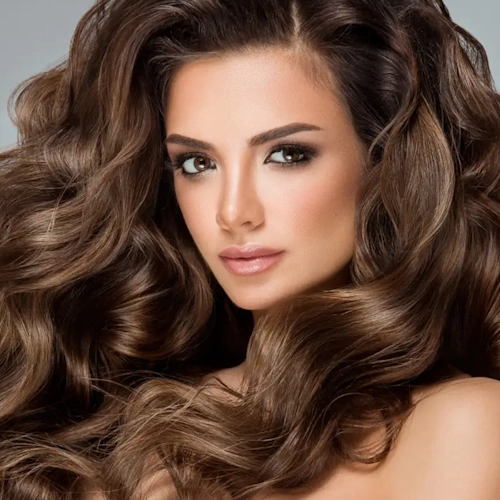
Make yours now
 Enough for 10 ten second videos




In 1932 Max Factor finished building a metal cage for the human head. The beauty micrometer held flexible strips against the face, allowed 325 adjustments and measured to a thousandth of an inch, all so that a makeup artist could be told which parts of an actor's face needed correcting before the camera magnified them. It never caught on. One is thought to survive, in a display at the Hollywood Entertainment Museum. Ninety years later we are still measuring our faces and still being told what to do about the results, except the tape measure is now a phone.

The Best Hairstyles for Round Faces
What to Ask For, What to Skip and How to Check First
Round face advice is some of the most repeated hair guidance on the internet, and a fair amount of it contradicts itself. One guide tells you to take a deep side parting. The next says a centre parting is the only thing that works. So here is the short answer first, then the reasoning, then the bits where the sources genuinely disagree and you have to decide for yourself.
The short version: length below the jaw, layers that begin under the chin, height at the crown, and a diagonal somewhere. Everything else in this guide is detail sitting on top of those four things.
Cut a blunt bob at exactly chin level on a round face and you have drawn a horizontal line across the widest part of it.
Do You Actually Have a Round Face?
Plenty of people who think they have a round face have full cheeks and a soft jaw on a face that is longer than it is wide, which is a different situation with different answers. Two minutes with a soft tape measure settles it. Pull your hair back, stand in front of a mirror in good light, and take four measurements.
- Forehead. Across the widest part, roughly halfway between your brows and your hairline
- Cheekbones. Straight across from the outer corner of one eye to the outer corner of the other
- Jaw. At its widest, about an inch below the ear, or measure from one earlobe to the tip of your chin and double it
- Length. From the centre of your hairline down to the bottom of your chin
A round face comes out roughly as wide as it is long. The cheekbones are the widest of the three widths, the forehead and jaw land fairly close to each other, and the chin curves rather than corners. If the length beats the widths by a clear margin, you have an oval or an oblong face and most of what follows stops applying. If the jaw is the widest measurement and it has corners in it, that is square.
Round and square get confused constantly, and the difference matters more than the labels suggest. Both are wide. Only one of them has angles in it already, and hair that softens a square jaw will do nothing useful for a round one.
Why Does Round Face Advice Contradict Itself?
Because face shape was never a science. It is a set of proportional rules borrowed from portrait painting, formalised by the film industry once close-ups started magnifying everything, and repeated ever since because it makes hair easy to write about in categories.
Stylists are noticeably less attached to the categories than the articles are. Sam McKnight, whose clients have included Princess Diana and most of the fashion houses, told the Sunday Telegraph that it is more modern and youthful to adapt a cut to your hair type and features, since no one's face is the same and therefore no two haircuts should be identical. Stylists posting about this on TikTok make the same point more bluntly: your hair texture decides what a cut will actually do far more than your face shape does.
Hold on to that while you read the rest of this. Fine straight hair cut into a heavy shag will not behave the way the reference photo did, whatever your proportions. Growth patterns, a cowlick, a double crown, whether you own a hairdryer and whether you will use it three mornings a week, all of that outranks the shape of your face. Treat the round face rules as a starting position, not a verdict.
What Actually Suits a Round Face?
Four things, and they come from one idea. A round face is wide at the cheeks and soft at the jaw, so hair that adds width at ear level is competing with it, and hair that adds vertical lines is not.
Length that clears the jaw
Anything ending below the jawline pulls the eye down past the widest part of the face. That is why long hair, collarbone lengths and long bobs all read as flattering here while chin length is the awkward middle. If you want short hair, go properly short rather than stopping halfway.
Layers that start under the chin
Layers put movement and vertical breaks into the hair. Start them too high and you build volume at the cheeks, which is the one place you do not want it. Ask for the shortest layer to sit at or below the chin, with face-framing pieces cut on a long diagonal.
Height at the crown
Volume on top adds length to the whole head and costs nothing but a bit of root lift. Blow dry the roots against the direction they grow, or use a little powder up there. This is the fastest change available and it works at every length, including a pixie.
An angle somewhere
A diagonal cuts across a curve. The angle can come from an off-centre parting, an A-line bob that is longer at the front, a swept fringe or asymmetric face-framing. One diagonal is usually enough, and it is the detail most people skip.

The Cuts Worth Asking For
Bobs and lobs have run the salon booking system for two years now, and most of the variations trending in 2026 happen to be shapes that suit a round face. Convenient, if you have one.
The long bob, cut below the jaw
The safest short option here. Have it fall an inch or two below the jawline rather than at it, and ask for the ends to be textured or point cut so the bottom edge is not a solid horizontal bar. Paired with curtain bangs it is one of the combinations salons report being asked for most.
The A-line or angled bob
Shorter at the back, longer at the front, so the length framing your face does the elongating while the back keeps its shape. The angle is the whole point of it. A steeper angle gives you more of the effect, and it holds up on straight hair better than layers do.
Long layers
The lowest maintenance answer on this list. Keep the length, put in layers that begin below the chin, add long face-framing pieces falling towards the collarbone. It suits thick hair particularly well because the weight comes out of the sides rather than the top.
The soft shag
The shag has been getting gentler through 2026, feathered rather than choppy. It breaks up the outline of the hair with texture, so a round face is not framed by a smooth curve. Wavy and curly hair get the most out of it. Fine hair needs product to hold it.
Curtain bangs
Shorter through the middle, longer at the sides, sweeping away from the face. John Frieda's stylists put round faces at the top of the list for these, because the longer sides do the elongating. They also grow out without the awkward stage a blunt fringe puts you through.
A pixie with height
Short hair is not off limits, it just has to be built upwards. Volume through the top, tight at the sides, and a longer piece left at the front to sweep across. What does not work is a rounded crop with equal fullness all over, which mirrors the shape of the face straight back at itself.
Try it with NeonSnap
See the cut on your own face before the appointment
Face shape rules are built on an average set of proportions, which is not what anyone actually has. NeonSnap's free AI Hair Change tool applies a lob, curtain bangs, long layers or a pixie to a photo of you, which tells you more in thirty seconds than a page of proportional advice will.
Try AI Hair Change free →What Should You Avoid With a Round Face?
Fewer things than the internet claims, and the ones that matter all come down to horizontal lines.
- The blunt chin-length bob. It ends at the widest point of the face and squares the whole thing off. This is the one cut almost every stylist warns against here, and the fix is two inches in either direction
- A heavy blunt fringe. Cutting straight across the forehead removes length from the visible face and adds width at the same time. Wispy, side-swept or curtain versions give you a fringe without that trade
- Volume at ear level. Wide waves starting at the cheekbone, a bob that kicks out at the ends, a blow dry brushed outwards at the sides. Volume is welcome higher up and unhelpful there
- One length, flat, no texture. Hair with no layers and no root lift hangs like a curtain either side of the face and leaves the eye nothing vertical to follow
- Tight symmetrical curls set around the face. A halo of round shapes around a round face repeats the outline. Loosening the curl pattern at the front, or wearing the front pieces longer, breaks it up
None of these are rules in the sense that they cannot be broken. They are the cuts most likely to make you say the haircut looks wrong without being able to explain why.
Centre Parting or Side Parting?
This is where the guides split, and it is worth understanding rather than picking a side at random.
Most stylists say side parting. An off-centre part is an instant diagonal, it lets you pile the volume onto the heavier side, and the sweep of hair crossing the forehead breaks up the width up there. Deep side partings have been the standard round face recommendation for decades for exactly that reason.
The dissenters argue for a centre parting, on the grounds that it drops a straight vertical line down the middle of the face and lets the hair fall close on both sides. That works, with one condition: the hair has to lie flat. A centre parting on hair that puffs out at the ears gives you two symmetrical wings framing the widest part of your face, which is precisely what you were trying to avoid.
So the honest version is that both work and they fail differently. Photograph yourself in each on the same day, in the same light, and look at the two side by side. Photographs settle this argument faster than mirrors do, which is also true of most things in our guide on how to look good in photos.
What About Men With Round Faces?
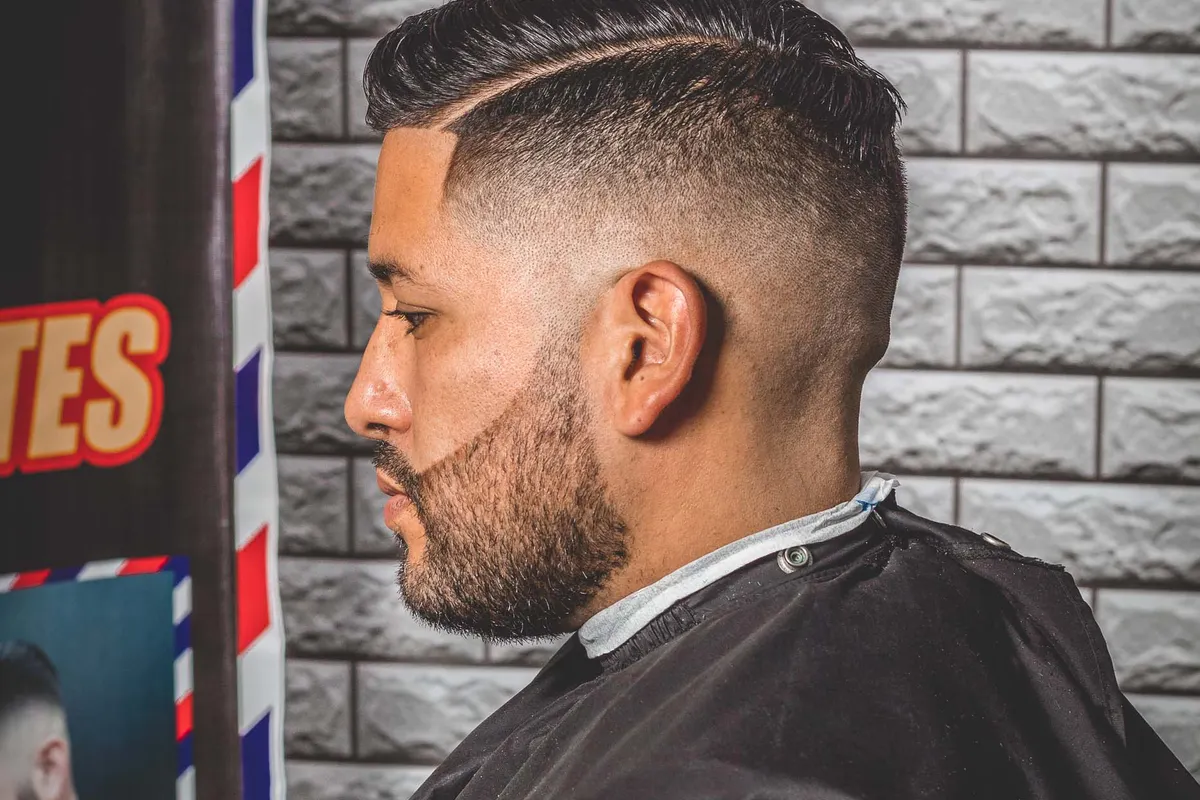
Same principle, different vocabulary. Take the width off the sides and put the height on top.
In practice that means a high fade or a high taper rather than a low one, since a low fade leaves bulk exactly where a round face is already widest. On top, ask for enough length to style upwards, then use a matte clay or paste instead of anything that lies the hair flat. A textured quiff, a pompadour or a longer crop with volume all work. A short back and sides with a flat top does not, and neither does a full buzz cut, which puts the outline of your head on display with nothing to interrupt it.
Facial hair does more here than the haircut. A short beard with squared off edges along the jaw builds the corners a round face does not have, and plenty of men find it changes their proportions more than anything a barber does above the ears. There is more on that in our male grooming guide.
Does the 2.25 Inch Rule Work?
You will run into this one if you search for long enough. John Frieda came up with it after studying photographs of hundreds of faces. Hold a pencil horizontally under your chin, hold a ruler vertically against your ear so that the two cross, and read off the distance from the bottom of your earlobe to the pencil. Under 2.25 inches, or 5.5 cm, and short hair is said to suit you. Over it, keep the length.
It is a measurement of jaw angle dressed up as a verdict, and it takes nothing else into account. Not your hair texture, not your height, not your neck, not the actual shape of your face, not whether you can be bothered to blow dry a bob. Hairfinder, which has been publishing the rule for years, says outright that the formula does not account for enough differentials and that plenty of people with the wrong number look excellent with short hair.
Use it as a tiebreaker if you are stuck between two lengths. Do not let it talk you out of a haircut you want.
How Do You Check Before You Book?
Every rule on this page is a generalisation about an average face, and the value of it drops the moment you look at a specific one. There are two ways past that. A proper consultation with a stylist who will actually look at your hair, and seeing the cut on your own face first.
The second one used to mean holding a magazine up next to your head. Now you can upload a photo to NeonSnap's free AI Hair Change tool and see a lob, long layers, curtain bangs or a pixie applied to your own face, with your colouring and your proportions. Run three or four options, screenshot the ones that work, and take those to the appointment. It is a far better brief than a photo of a stranger.
Worth trying the cut you have been told not to have as well. People find surprisingly often that it suits them anyway, and it costs nothing to look. Our guide to the AI hairstyle try-on walks through the styles you can preview, the curtain haircut guide covers the fringe in detail if that is the direction you are heading, and if colour is on your mind at the same time, what hair colour suits me takes the same approach to undertones.
Frequently Asked Questions
What haircut suits a round face?
Length below the jaw, layers that start under the chin, and some height at the crown. A long bob cut past the jawline, long layers, a soft shag or curtain bangs all do that job. The aim is to put vertical lines into the hair rather than horizontal ones, because a round face is roughly as wide as it is long and its widest point sits at the cheekbones.
How do I know if my face is round?
Measure four things with a soft tape: the width of your forehead, the width across your cheekbones, the width of your jaw, and the length from hairline to chin. A round face comes out roughly as wide as it is long, with the cheekbones the widest of the three widths and a jaw that curves rather than corners. If your face is clearly longer than it is wide, you are looking at oval or oblong instead.
Do bobs suit round faces?
Yes, as long as the length is chosen deliberately. A blunt bob that stops at chin level draws a horizontal line across the widest part of the face. Take it below the jaw as a lob, or above the chin, and cut it at an angle so the front pieces fall longer than the back. Some texture through the ends helps as well, because a heavy solid edge reads as a straight line.
Should I get a fringe if I have a round face?
A fringe works, but not a heavy blunt one. Thick hair cut straight across the forehead shortens the face and widens it at the same time. Curtain bangs are the safer request, because the shorter middle and longer sides put a downward line either side of the nose. Side-swept and wispy fringes do something similar. Ask for it longer than you think you want it, since trimming is easy and growing it out is not.
Is a centre parting or a side parting better for a round face?
Guides disagree, and both sides have a point. A deep side parting puts an off-centre diagonal across the head and lets you build height on the heavier side, which is why most stylists suggest it. A centre parting drops a vertical line down the middle of the face, which also lengthens the look of it, but only if the hair falls flat instead of puffing out around the ears. Try both in a mirror on the same day and photograph each one.
Can I see a haircut on my own face before booking it?
Yes. NeonSnap's free AI Hair Change tool puts a cut, style or colour onto a photo of your own face, so you can judge a lob, curtain bangs or a shag on your proportions rather than on a model's. It costs nothing to run, so try the cut you were talked out of as well as the one the rules say you should have.
Try a new cut on your own photo, free.
A lob, curtain bangs or a pixie on your face, before anyone picks up the scissors.
Try AI Hair Change free